Talk to EASTONTECH
We want to help you find the best option for your business. Tell us your need by filling out the form below and we will contact you as soon as possible!

|
Model |
EW-8930 |
|
Wire range |
AWG18-AWG24 |
|
Stripping length |
A side:0.1-6mm B side:0.1-10mm |
|
Cut precision |
±0.5mm+L*0.2% |
|
Cutting length |
90-900mm |
|
Capacity |
2000-2200pcs/hour (L=100mm) |
|
Crimping force |
2.0T |
|
Stroke |
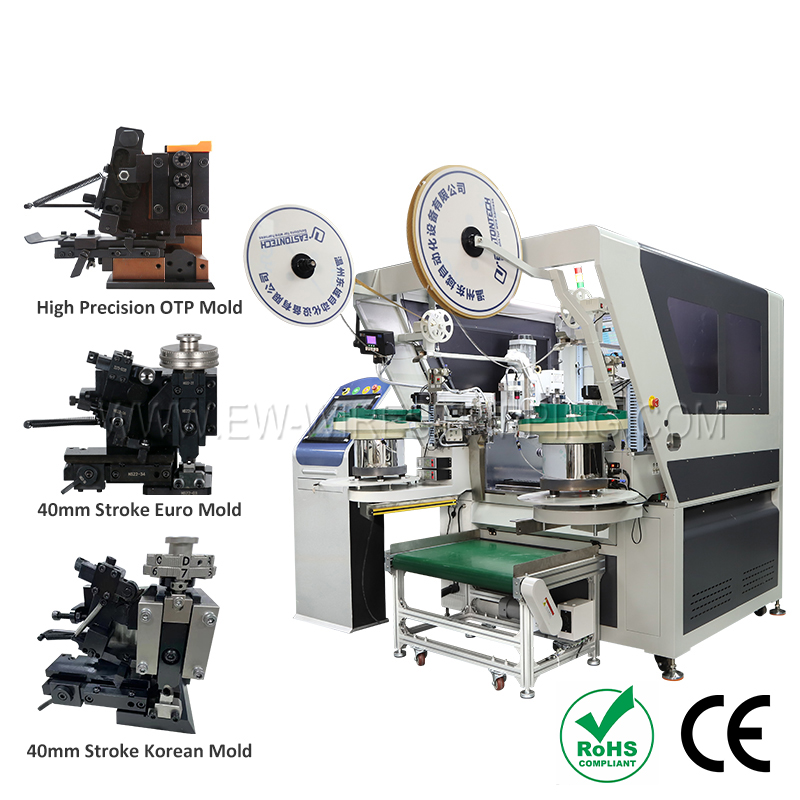
30mm |
|
Air pressure |
0.5-0.7Mpa |
|
Wire color |
8 color wires(must be the same specification) |
|
Max. Pin Number |
Single row 20 holes, maximum 3 rows |
|
Housing size |
MAX:40*25*25 MIN:5*6*3 Spacing 1.0-4.2mm |
|
Detection |
Low air pressure ,Wire run-out, Wire overload, Terminal run-out,Terminal overload, Crimp error, Insertion error |
|
Power |
220V/110V/50/60HZ |
|
Foot pedal start |
N/A |
|
Dimension |
2400*1500*1850mm |
|
Weight |
800Kg |
|
Standard includes |
CCD visual Inspection; CFM; Wire feeder |
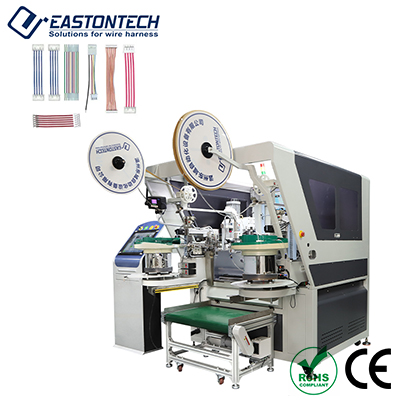
● Double-End Housing Connector Insertion in One Automated Cycle
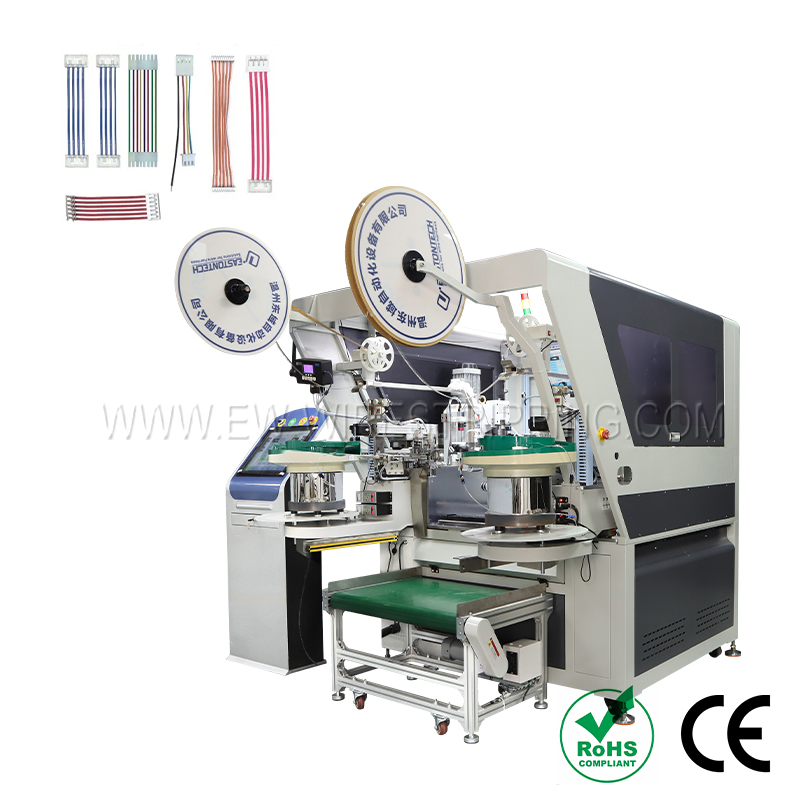
The EW-8930 completes cutting, stripping, terminal crimping, and housing connector insertion on both wire ends within a single automated cycle — distinguishing it from single-end insertion machines that crimp one end as a plain terminal. This is the right configuration for harness designs where both ends terminate into pin-header style housing connectors, such as board-to-board jumper cables and dual-connector signal harnesses.
● Independent Double-Knife Seat for Asymmetric Stripping Lengths
The two ends are stripped using an independent double-knife seat, allowing Side A (0.1–6mm) and Side B (0.1–10mm) to be set to different stripping lengths without compromise — important when the housing connectors at each end have different recess depths or pin insertion geometries requiring different exposed conductor lengths.
● 3-Axis Split Insertion with Guided Accuracy
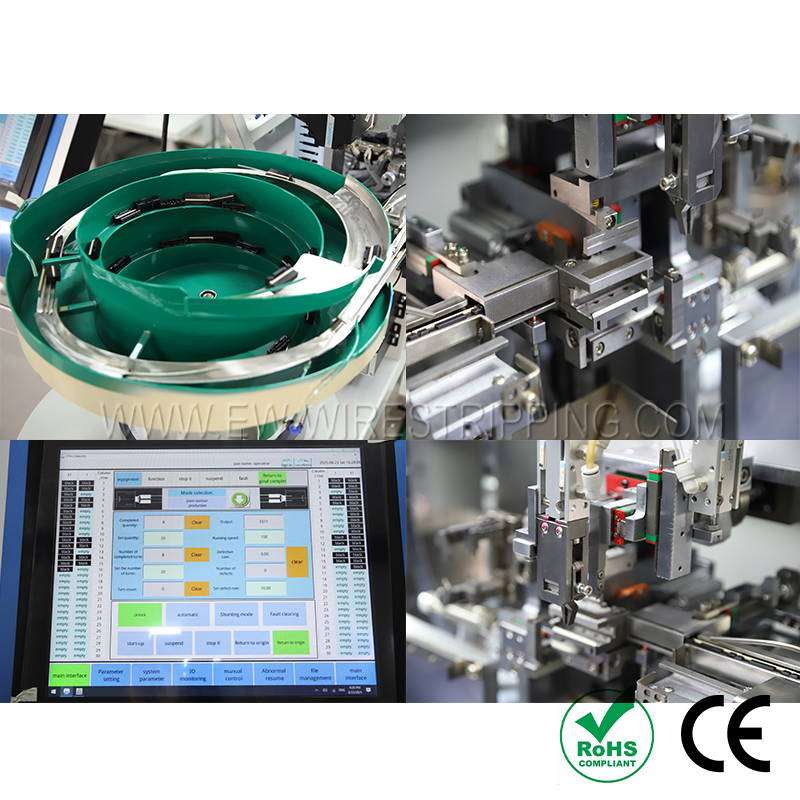
Housing insertion uses a 3-axis split operation combined with a guided insertion method, separating the approach, alignment, and locking confirmation stages rather than a single push action. This protects the terminal's functional contact area from bending damage during insertion and improves alignment accuracy on tight-pitch housings (down to 1.0mm pin spacing).
● CCD Inspection, CFM, and Flip-Type Reject Separation — All Standard
Unlike configurations where quality monitoring is optional, the EW-8930 includes CCD visual inspection, a crimping force monitor (CFM), and a wire feeder as standard equipment. Combined with the flip-type defective product isolation mechanism, this provides 100% automatic segregation of conforming and non-conforming output without operator sorting — a built-in quality architecture rather than an add-on.
Board-to-board jumper and signal cable assembly
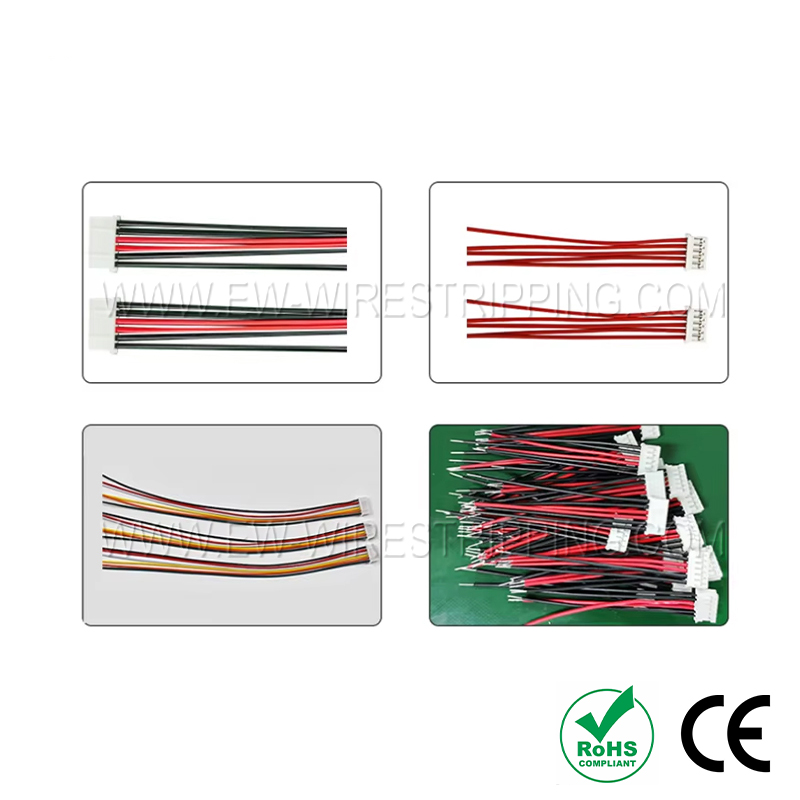
Jumper cables and internal signal cables connecting two PCB-mounted pin headers require housing connector insertion at both ends — the EW-8930's double-end capability produces these assemblies in one automated cycle, where single-end insertion machines would require a secondary manual or semi-automatic step for the second end.
Automotive sensor and ECU dual-connector harnesses
Sensor cables and short inter-module harnesses that terminate into housing connectors at both ends (sensor-side and ECU-side, for example) benefit from the EW-8930's symmetric double-end processing, with independently set stripping lengths accommodating different connector designs at each end.
Consumer electronics internal cable assemblies
Internal cable assemblies connecting two internal PCB connectors within computers, consumer electronics, and appliances — where both ends use multi-pin housing connectors — match the EW-8930's processing capability directly, supported by its 1.0–4.2mm pin pitch range covering common internal connector families.
High-reliability harness production requiring full quality documentation
Applications requiring documented, 100% inspected terminal crimping and insertion quality — automotive Tier 1 sub-assemblies, aerospace internal wiring, or any production line under IATF 16949 — benefit from the EW-8930's standard-equipped CCD and CFM, which provide per-cycle quality data without requiring a separate equipment upgrade decision.
Q: What is the difference between the EW-8930 and a single-end housing insertion machine?
A: The EW-8930 inserts terminals into connector housings on both wire ends in the same automated cycle, while single-end insertion machines (such as Eastontech's EW-8220) crimp one end as a plain terminal without housing insertion and only insert the housing on the opposite end. Select the EW-8930 when your harness design requires housing connectors at both ends, such as board-to-board jumper assemblies or dual-connector sensor cables.
Q: Why does the machine use an independent double-knife seat for stripping?
A: Side A strips to 0.1–6mm and Side B strips to 0.1–10mm — these are independently configurable because the connector housings at each end of a harness often have different recess depths or pin geometries that require different exposed conductor lengths. The independent double-knife seat allows both stripping lengths to be set and adjusted separately without one side constraining the other.
Q: Are CCD inspection and the crimping force monitor standard equipment, or optional?
A: On the EW-8930, CCD visual inspection, the crimping force monitor (CFM), and the wire feeder are included as standard equipment on every unit — they are not optional add-ons. Combined with the flip-type defective product isolation mechanism, this provides built-in, automatic quality segregation without requiring a separate equipment decision at the time of purchase.
Q: What wire colours and housing sizes does this machine support?
A: The machine processes up to 8 wire colours simultaneously, provided all colours share the same wire specification (gauge and insulation type). Housing dimensions range from 5×6×3mm (minimum) to 40×25×25mm (maximum), with pin pitch from 1.0mm to 4.2mm, up to 20 holes per row and up to 3 rows — covering most multi-pin housing connector families used in board-to-board and sensor harness applications.


Talk to EASTONTECH
We want to help you find the best option for your business. Tell us your need by filling out the form below and we will contact you as soon as possible!